01
HISTORY
A sourced chronology of the Revolution of Dignity and its consequences.
Maidan is not a legend. It is the story of citizens who defended their rights — and yours; their dignity — and yours; their freedom — and yours; Ukraine’s democratic choice — and, with it, Europe’s.
Each chapter answers the previous one. Revolution leads to faces; faces to music; music to the Bell; the Bell to Europe; Europe to the future.
Dignity becomes action.
02Repression breaks bodies.
03Names refuse oblivion.
04Silence becomes work.
05Matter becomes memory.
06Kyiv becomes transmission.
07Memory becomes duty.
A sourced chronology of the Revolution of Dignity and its consequences.
The 107 Heroes of Maidan, named and linked to their individual records.
Music and Bell presented as memorial creations, never as archival sound.
Refuse humiliation, arbitrariness and fear.
Defend the freedom to choose, speak and protest.
Protect a people’s sovereignty and democratic future.
Ensure that their sacrifice continues to protect those who come after us.
The site abandons romantic framing. It begins with a civic uprising, repression and deaths, then the political victory of dignity and the continuing struggle for freedom.
The government suspends preparations for the Association Agreement with the European Union. Students and citizens gather on Maidan.
Berkut violently disperses students. The brutality turns the protest into a mass mobilisation against authoritarianism, corruption and rights abuses.
Repressive laws seek to restrict the right to protest. Maidan becomes a barricaded camp of civic resistance.
Violence reaches its peak. Snipers and security forces use firearms against protesters. 20 February is the deadliest day.
Viktor Yanukovych leaves Kyiv and then Ukraine. Parliament records that he is no longer carrying out his duties and organises the political transition.
Russian forces — initially deployed without insignia — seize strategic sites in Crimea. Russia illegally annexes the peninsula and armed aggression then spreads to Donbas.
The European choice brings citizens into the streets.
Repression turns protest into a national uprising.
The barricades hold despite the assaults.
Dozens of protesters are killed by gunfire.
Their names become a responsibility of remembrance.
Every profile contains a portrait, full name, dates, a short biography and a message to the future. Portraits come from the NebesnaSotnya.com memorial site and are attributed to their source.

« They sacrificed their breath so that you could breathe… »

« They sacrificed their breath so that you could breathe… »

« They sacrificed their breath so that you could breathe… »

« They sacrificed their breath so that you could breathe… »

« They sacrificed their breath so that you could breathe… »

« They sacrificed their breath so that you could breathe… »

« They sacrificed their breath so that you could breathe… »

« They sacrificed their breath so that you could breathe… »

« They sacrificed their breath so that you could breathe… »

« They sacrificed their breath so that you could breathe… »

« They sacrificed their breath so that you could breathe… »

« They sacrificed their breath so that you could breathe… »

« They sacrificed their breath so that you could breathe… »

« They sacrificed their breath so that you could breathe… »

« They sacrificed their breath so that you could breathe… »

« They sacrificed their breath so that you could breathe… »

« They sacrificed their breath so that you could breathe… »

« They sacrificed their breath so that you could breathe… »

« They sacrificed their breath so that you could breathe… »

« They sacrificed their breath so that you could breathe… »

« They sacrificed their breath so that you could breathe… »

« They sacrificed their breath so that you could breathe… »

« They sacrificed their breath so that you could breathe… »

« They sacrificed their breath so that you could breathe… »

« They sacrificed their breath so that you could breathe… »

« They sacrificed their breath so that you could breathe… »

« They sacrificed their breath so that you could breathe… »

« They sacrificed their breath so that you could breathe… »

« They sacrificed their breath so that you could breathe… »

« They sacrificed their breath so that you could breathe… »

« They sacrificed their breath so that you could breathe… »

« They sacrificed their breath so that you could breathe… »

« They sacrificed their breath so that you could breathe… »

« They sacrificed their breath so that you could breathe… »

« They sacrificed their breath so that you could breathe… »

« They sacrificed their breath so that you could breathe… »

« They sacrificed their breath so that you could breathe… »

« They sacrificed their breath so that you could breathe… »

« They sacrificed their breath so that you could breathe… »

« They sacrificed their breath so that you could breathe… »

« They sacrificed their breath so that you could breathe… »

« They sacrificed their breath so that you could breathe… »

« They sacrificed their breath so that you could breathe… »

« They sacrificed their breath so that you could breathe… »

« They sacrificed their breath so that you could breathe… »

« They sacrificed their breath so that you could breathe… »

« They sacrificed their breath so that you could breathe… »

« They sacrificed their breath so that you could breathe… »

« They sacrificed their breath so that you could breathe… »

« They sacrificed their breath so that you could breathe… »

« They sacrificed their breath so that you could breathe… »

« They sacrificed their breath so that you could breathe… »

« They sacrificed their breath so that you could breathe… »

« They sacrificed their breath so that you could breathe… »

« They sacrificed their breath so that you could breathe… »

« They sacrificed their breath so that you could breathe… »

« They sacrificed their breath so that you could breathe… »

« They sacrificed their breath so that you could breathe… »

« They sacrificed their breath so that you could breathe… »

« They sacrificed their breath so that you could breathe… »

« They sacrificed their breath so that you could breathe… »

« They sacrificed their breath so that you could breathe… »

« They sacrificed their breath so that you could breathe… »

« They sacrificed their breath so that you could breathe… »

« They sacrificed their breath so that you could breathe… »

« They sacrificed their breath so that you could breathe… »

« They sacrificed their breath so that you could breathe… »

« They sacrificed their breath so that you could breathe… »

« They sacrificed their breath so that you could breathe… »

« They sacrificed their breath so that you could breathe… »

« They sacrificed their breath so that you could breathe… »

« They sacrificed their breath so that you could breathe… »

« They sacrificed their breath so that you could breathe… »

« They sacrificed their breath so that you could breathe… »

« They sacrificed their breath so that you could breathe… »

« They sacrificed their breath so that you could breathe… »

« They sacrificed their breath so that you could breathe… »

« They sacrificed their breath so that you could breathe… »

« They sacrificed their breath so that you could breathe… »

« They sacrificed their breath so that you could breathe… »

« They sacrificed their breath so that you could breathe… »

« They sacrificed their breath so that you could breathe… »

« They sacrificed their breath so that you could breathe… »

« They sacrificed their breath so that you could breathe… »

« They sacrificed their breath so that you could breathe… »

« They sacrificed their breath so that you could breathe… »

« They sacrificed their breath so that you could breathe… »

« They sacrificed their breath so that you could breathe… »

« They sacrificed their breath so that you could breathe… »

« They sacrificed their breath so that you could breathe… »

« They sacrificed their breath so that you could breathe… »

« They sacrificed their breath so that you could breathe… »

« They sacrificed their breath so that you could breathe… »

« They sacrificed their breath so that you could breathe… »

« They sacrificed their breath so that you could breathe… »

« They sacrificed their breath so that you could breathe… »

« They sacrificed their breath so that you could breathe… »

« They sacrificed their breath so that you could breathe… »

« They sacrificed their breath so that you could breathe… »

« They sacrificed their breath so that you could breathe… »

« They sacrificed their breath so that you could breathe… »

« They sacrificed their breath so that you could breathe… »

« They sacrificed their breath so that you could breathe… »

« They sacrificed their breath so that you could breathe… »

« They sacrificed their breath so that you could breathe… »

« They sacrificed their breath so that you could breathe… »

« They sacrificed their breath so that you could breathe… »
A documentary gallery of the 107 Heroes of the Heavenly Hundred. Touch a face to open its memory.
Each line is a symbolic presence. None replaces a face, biography or story; it simply reminds us that collective remembrance begins with the individual.
The player is now autonomous: all ten MP3s are hosted inside the site, the Bell is a real local audio file, and a native HTML5 audio player remains available as an iPhone/Safari fallback.
The player is now autonomous: all ten MP3s are hosted inside the site, the Bell is a real local audio file, and a native HTML5 audio player remains available as an iPhone/Safari fallback.
The Bell now has its own chamber: a sound space separated from the rest of the journey, where resonance deliberately comes before silence.
The Bell now has its own chamber: a sound space separated from the rest of the journey, where resonance deliberately comes before silence.
The four founding works of the project are presented intact, as in a digital exhibition room. No website text is placed over the artworks.
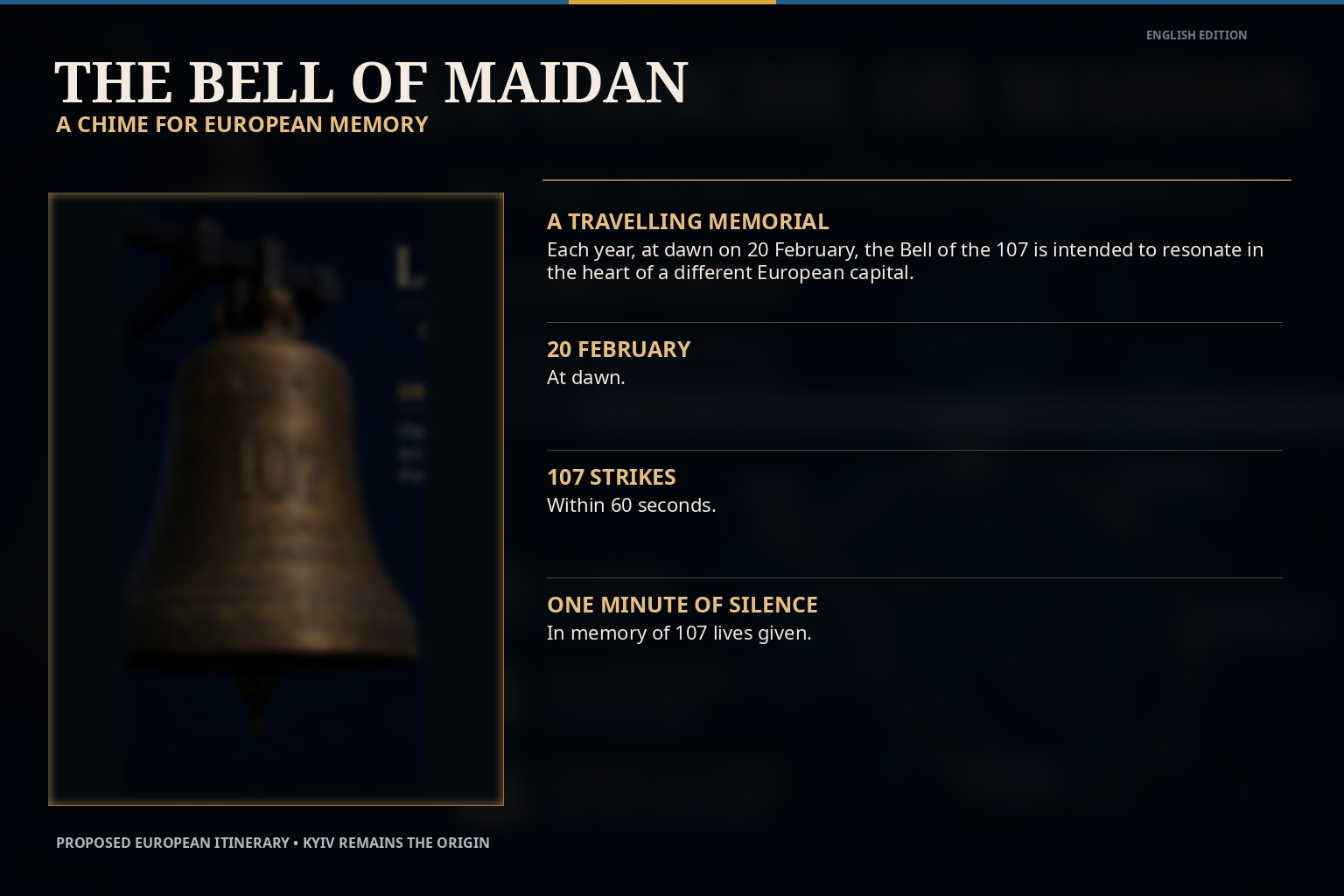
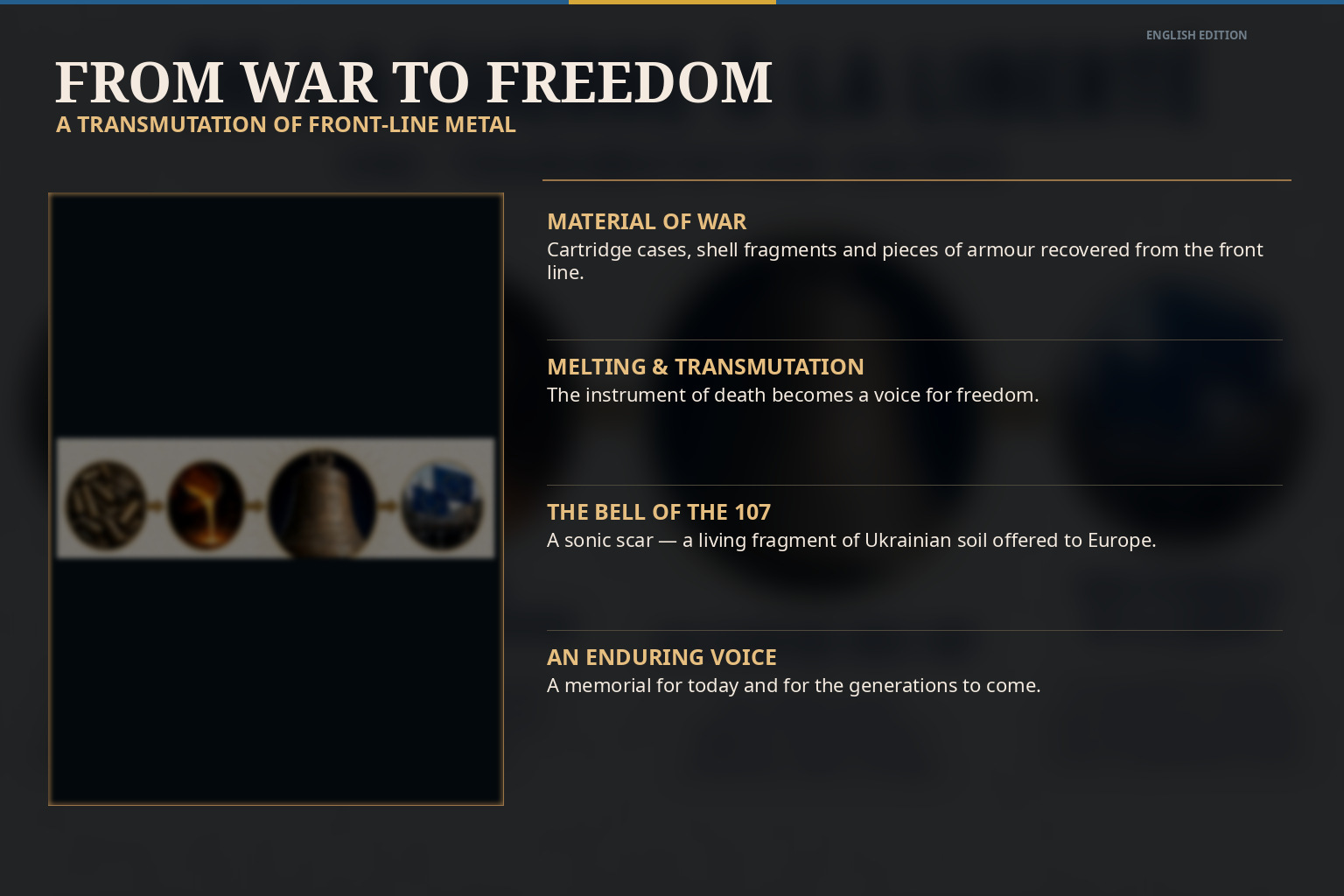
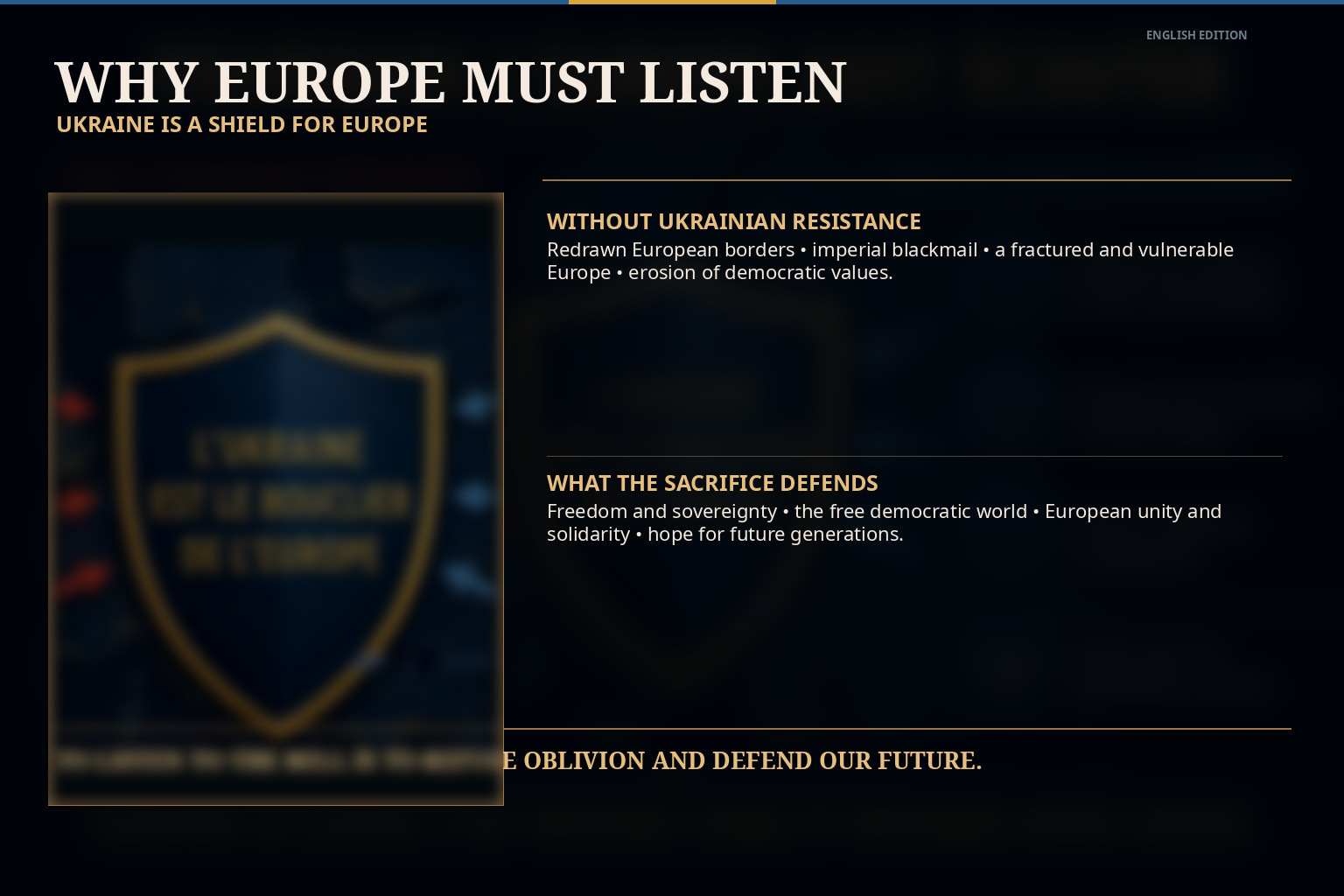
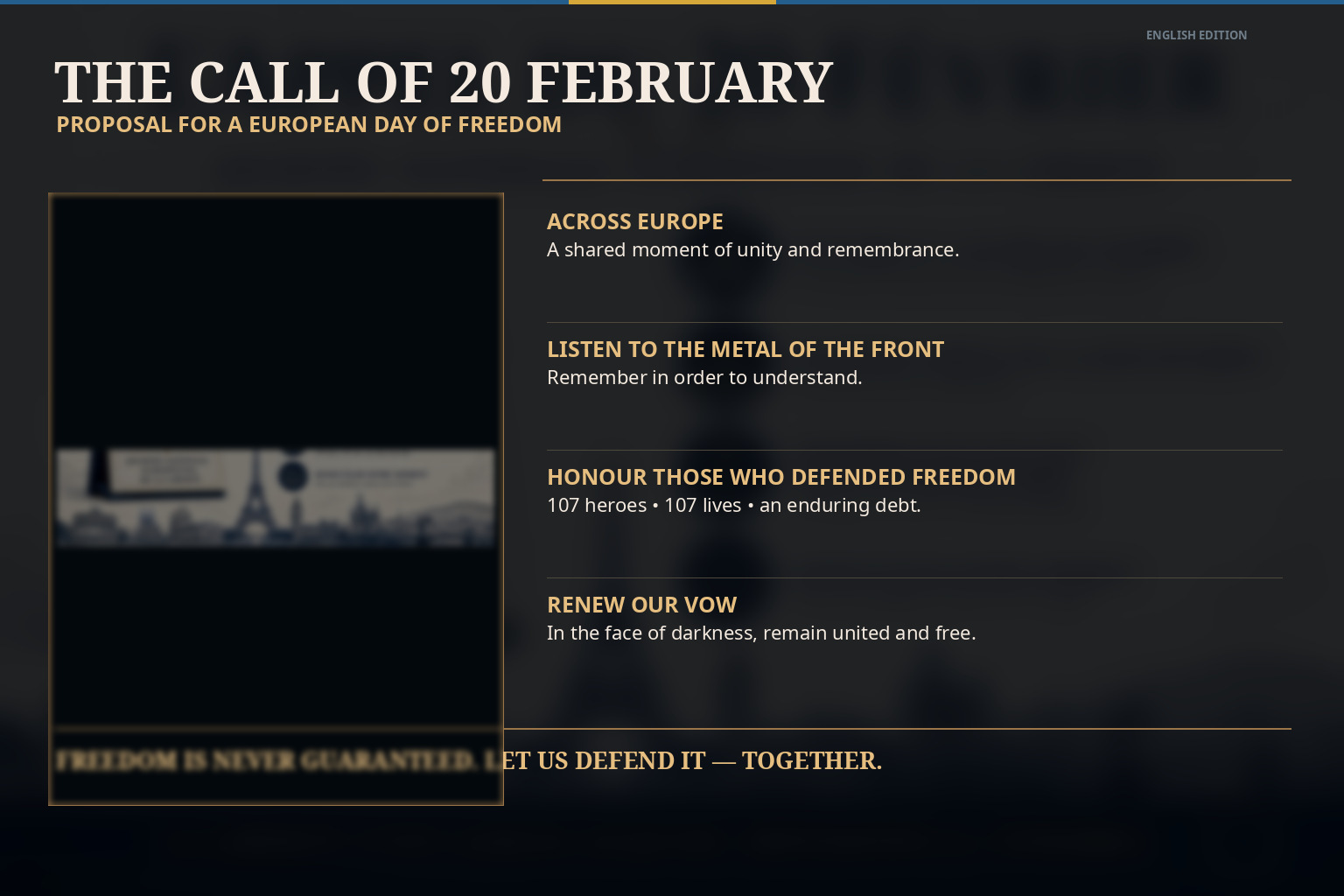
The visual monument is now carried by the project’s artworks. Here, the site no longer imitates bronze: it gives form only to its resonance — wave, breath, silence and memory.
Europe’s history is often written in the quiet rooms of diplomacy, but in moments of great peril it is forged in the blood and courage of peoples. On 20 February 2014, on the frozen paving stones of Maidan, the Ukrainian nation paid in blood to wrest its destiny from tyranny and bind it, irrevocably, to the European family. That day, one hundred and seven destinies were cut short by a regime at bay, forming the Nebesna Sotnia — the Heavenly Hundred. So that this date is never confined to the margins of Ukrainian history, but takes its rightful place at the heart of continental consciousness, we carry today a work of remembrance and struggle: the Bell of the 107.
Memory cannot be satisfied with mute marble; it requires a voice capable of piercing time. The Bell of Maidan will not be cast from an ordinary alloy. It will be the outcome of a sacred alchemy, forged from cartridge cases, shell fragments and pieces of armour recovered from the front line that is tearing through the East and South of Ukraine. Brass and steel once manufactured by Russia to spread death and subjugation will be melted and transmuted. The instrument of our destruction will become the eternal voice of our freedom. This Bell will be a sonic scar, a living fragment of wounded Ukrainian soil, offered to Europe as a whole.
Because freedom is a permanent struggle, the Bell of the 107 will refuse immobility. It is intended to become a travelling monument, an embassy of memory. Each year, at the dawn of 20 February, it will take its place in the heart of a different European capital — Paris, Berlin, Warsaw, Brussels, Rome.
There, at the centre of public space, a ritual of absolute sobriety will take place: a majestic minute of silence, crossed by one hundred and seven strikes. One hundred and seven deep, clear and solemn blows, sounded within sixty seconds. A compression of time in which each vibration will carry the name and soul of a fallen hero. One beat for one life given, so that oblivion — the second death of those who fought — may be defeated forever.
Why should Europe stop to listen to this toll? Because, in honouring these sacrificed lives, it contemplates its own survival. What would the European continent look like today without Ukraine’s absolute resistance? Had the Ukrainian barrier collapsed, Russian armour would already be redrawing the borders of the Union. Europe would live in fear, fractured and subjected to the permanent blackmail of a predatory empire. The martyrs of 20 February were among the first to die, wooden shields in their hands, not only for the sovereignty of Kyiv but while raising the starry banner of Europe. Their sacrifice foreshadowed the great civilisational war we are fighting today.
From then on, the Bell sounds as a sentinel. Its metallic song is a warning to free nations: Russian fascism and its genocidal impulses will not stop of their own accord. To listen to the Bell is to refuse fatal naivety; it is to remember that democratic peace is a vulnerable fortress that must be defended every day, with arms if necessary.
Around this sounding monument must unfold the living substance of our history. By studying the mosaic of these one hundred and seven broken lives — teachers, students, workers, artists, fathers and sons — European citizens will no longer see a distant abstraction, but the intimate and fraternal face of a vibrant, educated and indomitable nation.
In this war, where Russia builds its hegemony on the falsification of history, imposing truth is an act of struggle and an indispensable pillar of final victory. The Bell of Maidan embodies that uncompromising truth.
For all these reasons, this manifesto carries a major political, moral and historical demand. We call on the institutions of the European Union and the heads of state of the continent to go beyond a solely Ukrainian national commemoration.
We ask that 20 February be officially proclaimed a European Day of Freedom. On that date, from one end of Europe to the other, nations should stand together, listen to the metal of the front line resonate, honour those who defended the free world, and renew together their unbreakable oath in the face of darkness.
Colonel Paul-Michel Manandise
“Remembrance cannot be satisfied with silent marble; it demands a voice capable of crossing time.”
The Manifesto becomes an autonomous visual sequence. The four artworks are presented intact: no caption, effect or website element covers their composition.
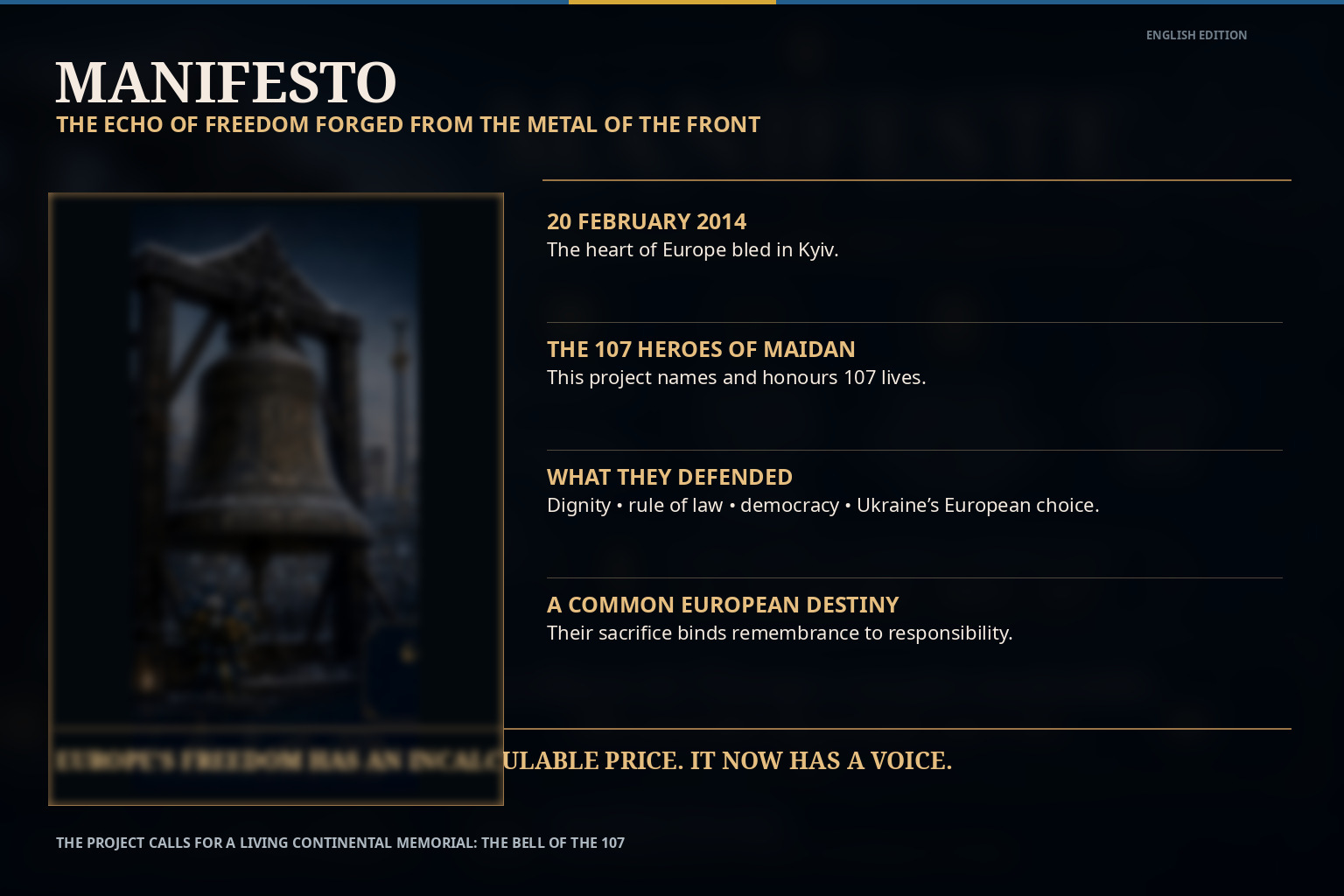
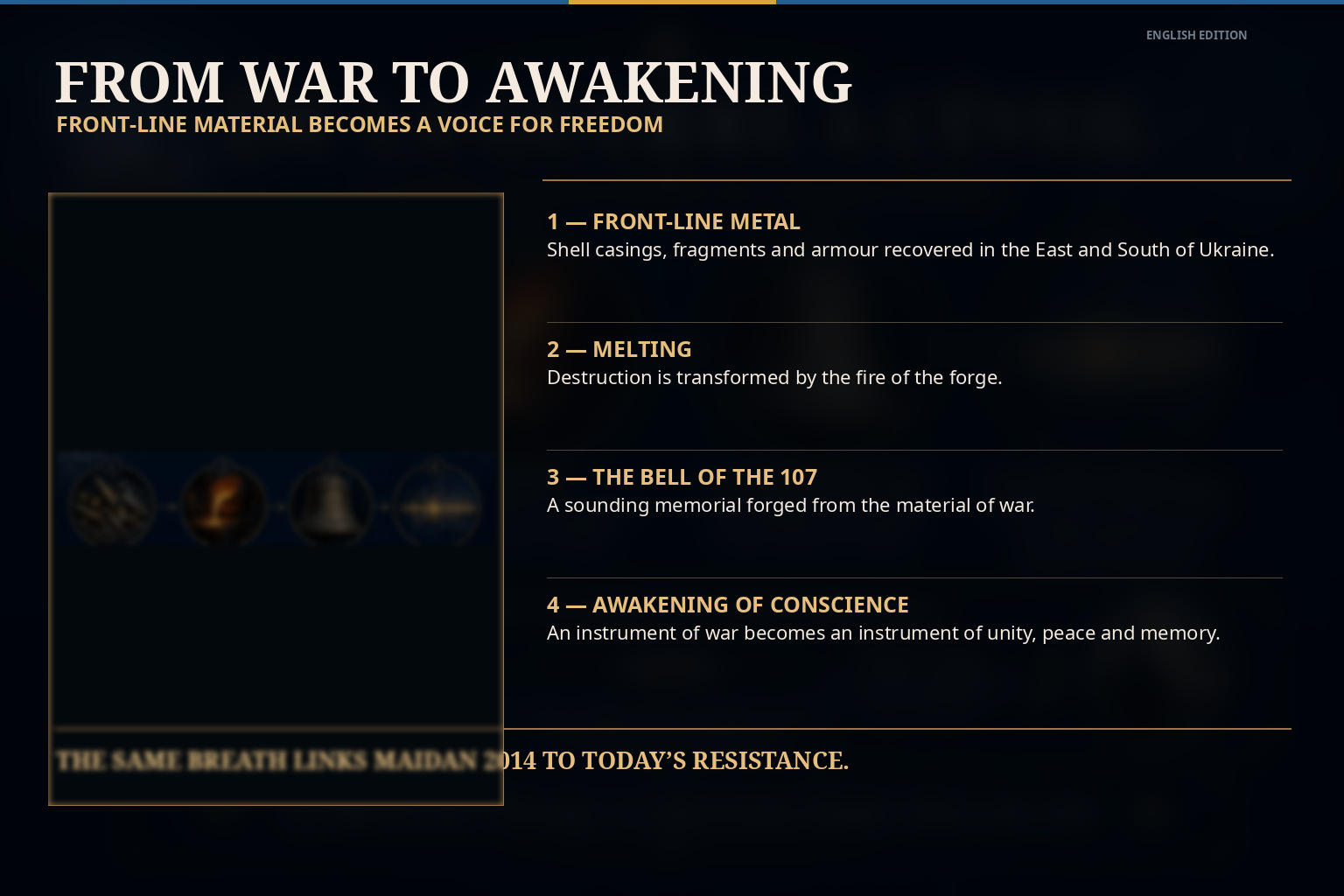
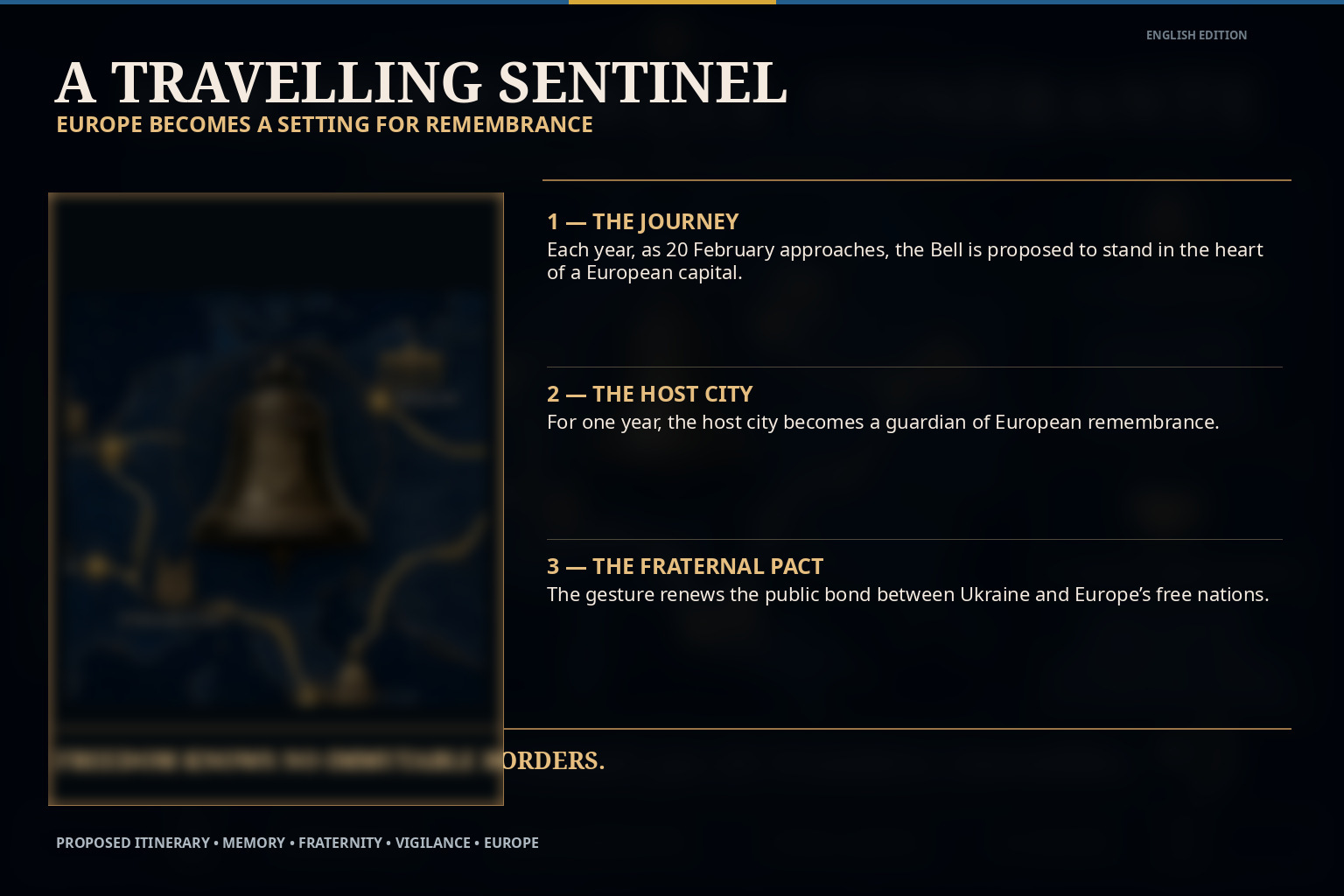
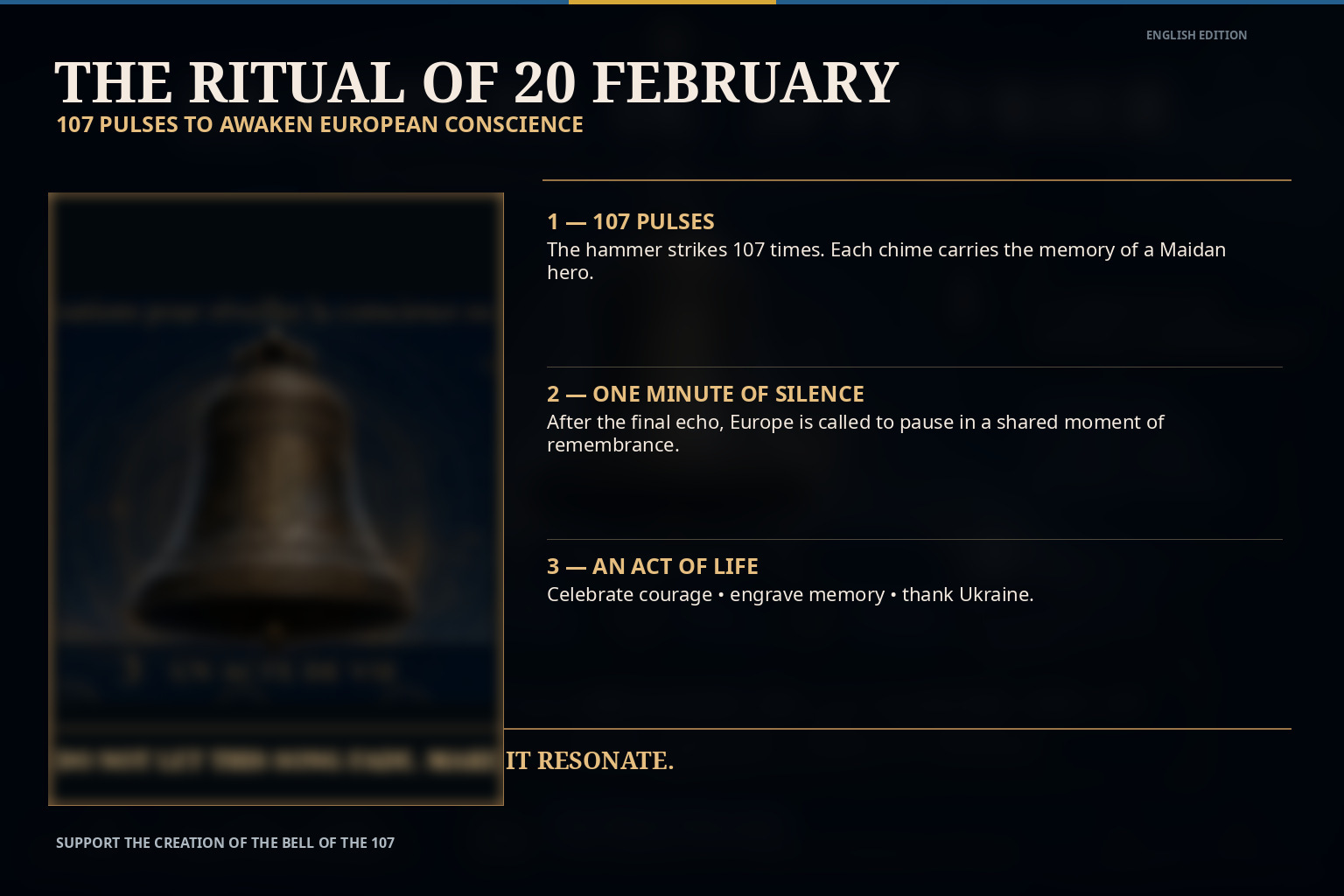
“Europe’s freedom has an incalculable price. It now possesses a voice.”
THE BELL OF THE 107The echo of freedom forged in the metal of the front.
There are sacrifices that the motionless coldness of marble and the blindness of stone cannot decently contain.
On 20 February 2014, the heart of Europe bled on the snow of Kyiv. That day, one hundred and seven Ukrainian citizens — those whom history mourns and reveres under the name of the Heavenly Hundred — fell under gunfire on Maidan.
Their bodies were broken, but their spirit set a nation ablaze. They did not merely give their lives to wrest their homeland from the darkness of tyranny; they were killed for raising Europe’s flag of golden stars. They died for the rule of law, human dignity, and for believing, at the risk of their existence, in a real and tangible democracy.
Their blood, mixed with the ashes of the barricades, sealed our common European destiny. It was here, on this square, that the struggle for the freedom of our continent began.
To honour this immeasurable debt, we refuse the frozen silence of conventional memorials, which too often fade into everyday forgetfulness. Today we call for the creation of a living, vibrating, sounding and profoundly continental monument: the Bell of the 107.
The Bell of the 107 will not be cast from a neutral or ordinary alloy, untouched by history. It will be forged from the very substance of our tragic and present struggle: the brass and copper of artillery and ammunition casings, carefully recovered from the current front line in the plains and trenches of eastern and southern Ukraine.
From destruction to awakening: there is an almost sacred transmutation in this act. We will take the raw material of war — metals that carried noise, destruction and death — and purify them in the fire of the forge. From these instruments of harm, we will bring forth an instrument of peace, unity and awakened conscience.
A physical and indestructible bond: this metal, pulled from the mud of the trenches and saturated with the effort and sweat of our soldiers, will carry the indelible DNA of Ukrainian resistance. It will weave an unbroken bronze thread between the founding blood shed on Maidan in 2014 and the immense struggle waged today, hour after hour, to guarantee the security and freedom of Europe as a whole.
Because the martyrs of Maidan died looking toward Europe, the European continent as a whole must become the setting for their memory. Freedom knows no immovable borders; neither will the Bell of the 107. It will be a travelling memorial, an itinerant sentinel, in the image of democratic values that move, breathe and bind our nations together.
The sacred journey: every year, as 20 February approaches, the Bell will begin its pilgrimage to stand at the heart of a major historical or political place in a European capital. Let it ring before the European Parliament in Strasbourg or Brussels, stand watch beneath the Brandenburg Gate in Berlin, or gather people at Place de la République in Paris.
The fraternal pact: the host city will assume, for an entire year, the honourable title of “Guardian of European Memory.” This diplomatic gesture will be more than a symbol; it will renew the solemn oath of fraternity linking the destiny of European nations with that of Ukraine.
The 107 Pulsations: the heavy bronze hammer will strike the Bell 107 times. Each deep, visceral note will cut through the winter air to remind European conscience of the unique, singular and irreplaceable soul of each hero who fell. One hundred and seven sound waves like one hundred and seven heartbeats refusing to stop.
The European Minute of Silence: after the final echo of the one hundred and seventh strike, as the vibration slowly dies in the air, the continent will be called to stillness. From Lisbon to Warsaw, from Rome to Stockholm, one minute of absolute silence will be observed. A suspended instant. A space outside time in which to hear the sound of our peace — a precious silence purchased at the price of Maidan’s fury and the daily roar of our trenches.
This project goes beyond mourning. The Bell of the 107 is not a funeral elegy; it is an act of life.
A celebration of the extraordinary, almost mythic courage of ordinary women and men who walked toward weapons of war with plywood shields and construction helmets as their only protection.
A memory forged to inscribe forever in our shared history an undeniable truth: the freedom enjoyed by the West today is not a natural possession. It is paid for, defended and won every day, in flesh and blood, on our eastern flank.
An immense gratitude. Every strike of this Bell will become Europe’s monumental, audible and enduring “thank you” to the Ukrainian people, who by the tragic force of history have become a shield of the free world.
Europe’s freedom has an incalculable price. It now possesses a voice.
Do not let this song die. Make it resonate. Support the creation of the Bell of the 107.
Paul Michel Manandise
Head of the Department of International Influence of Ukraine, with the National Security Information and Analysis Centre of Ukraine.
Mission officer with the State Fund for Aid to Ukraine on economic and humanitarian issues throughout Europe.
Representative of the “World Council on Global Security”, artist and citizen of the free world.
One hundred and seven rings. Then silence. A suspended moment in which the memory of Maidan becomes a European responsibility passed to future generations.
The origin of the journey: memory, dignity and resistance.
A memorial is not only a form. It is the decision to speak the names again and again, until they belong to everyone’s memory.
No signature is requested. The only proposed commitment is internal: do not let the names disappear, do not accept indifference, and do not treat freedom as an eternal given.
Freedom is not an abstraction. It has faces, names, dates and a price. The memory of the 107 does not ask us merely to look backward; it asks what we will do with the future.
For 107 seconds, the interface disappears. One mark of light appears each second. Time does not count the dead; it returns their presence to remembrance.


